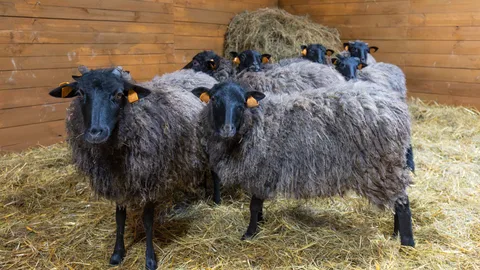
In the Faroe Islands, sheep’s wool has been intertwined for centuries with the fate of the people and the landscape. Once called the “gold of the Islands,” it long formed the basis of the economy and everyday life. Sheep arrived in the archipelago as early as the Viking Age, and the name Føroyar most likely means “Sheep Islands.” Wool was washed, combed, spun, and dyed with natural dyes derived from local plants and stones. It was used to make warm sweaters, socks, and other garments resistant to wind and rain, protecting inhabitants from the harsh North Atlantic climate. In the nineteenth century, wool was the Islands’ main export commodity. However, with the development of deep-sea fishing, its economic importance began to decline. In the second half of the twentieth century, this process accelerated: for many inhabitants, local wool became synonymous with backwardness and poverty. Farmers focused on meat, while wool, regarded as sticky, itchy, and unattractive, began to be thrown away or burned in sheepfolds on a mass scale. From a valuable raw material, it turned into something worthless—in the terms of Michael Thompson’s Rubbish Theory, it moved from the category of objects of declining value (Transient) into the category of Rubbish, that is, waste existing outside the system of value.
Since the beginning of the twenty-first century, however, we have seen a clear return of wool. This “woollen turn” is linked both to global trends in sustainable fashion and slow fashion, and to the revival of Faroese cultural identity. A major role was played by the international success of the series The Killing, in which the Danish detective Sarah Lund wore a distinctive Faroese sweater. Brands such as Guðrun & Guðrun and SHISA Brand began successfully exporting products made from local wool, emphasizing its ecological and cultural dimension. In 2024, the discovery in a London archive of a red sweater from the 1930s caused great excitement—an object that, from a forgotten artifact, became a national treasure.
Faroese knitting patterns are also of key importance. In 1932, Hans Marius Debes published the book Føroysk bindingarmynstur, which codified traditional motifs and gave them the status of a canon. On the one hand, it consolidated local tradition; on the other, it became a starting point for discussions about what is “authentically Faroese” and what may be creatively altered. These patterns became an element in the construction of an imagined national community in Benedict Anderson’s sense—a visible sign of the Faroe Islands’ distinctiveness from Denmark and the rest of the world.
A lively cultural debate is taking place today around wool and sweaters. Within it, one can identify the three groups of actors described by Thompson. The “High Priests”—guardians of tradition—defend the canon and the purity of patterns. The “Crashers Through”—designers and entrepreneurs—combine heritage with modernity, creating collections that achieve success on the global market. In turn, the “Levellers”—artists, young creators, and punk groups such as Joe and the Shitboys—question rigid rules, opening tradition up to experimentation and irony.
The Faroese national costume, often containing woollen elements, remains a symbolic battlefield over what it means to be Faroese in the twenty-first century. Wool symbolizes both pride in the past and a desire for a future based on sustainable development.
The history of Faroese wool shows how material objects can repeatedly change their position within a system of value. What was once the basis of existence became rubbish, only later to return as a valuable cultural and economic resource. Thompson’s Rubbish Theory helps us understand that such transformations are not accidental—they result from an ongoing struggle among different groups over the right to define what is valuable and what is worthless. In the Faroe Islands, wool is not just a material. It is a living element of identity, one that is continually being retold and transformed anew.
Gaini, F. (2026). The secret lives of wool. A Rubbish Theory case study from the Faroe Islands. In B. E. Singleton (Ed.), All that glitters is not garbage: Adventures in Rubbish Theory (pp. 69–108). Mayfly Books. ISBN 978-1-906948-82-5.